

Trump Accounts (Summer 2026 Update)
Trump Accounts Are Now LIVE: What Pennsylvania Parents Need to Know
By Tucker P. Nicholas, Private Wealth Advisor at PAC Financial, Harrisburg, PA. Updated July 17, 2026.
Trump Accounts opened for contributions on July 4, 2026. If your child was born in 2025 through 2028 and is a U.S. citizen with a Social Security number, the federal government will put $1,000 into an investment account in their name. You do not pay it back. PAC Financial helps families across Pennsylvania claim it and set the account up correctly. Call (717) 564-6400.
What is a Trump Account?
A Trump Account is an investment account for children under 18, created by the 2025 tax law. Money goes in after tax, gets invested in a stock market index fund, and grows tax-deferred until your child is an adult. In the year your child turns 18, the account becomes a traditional IRA in their name.
Think of it as a head start on lifelong investing, opened while your kids are still in car seats.
Who gets the $1,000 federal contribution?
Children born January 1, 2025 through December 31, 2028 who are U.S. citizens with a valid Social Security number. It is a one-time contribution from the U.S. Treasury, and it does NOT count against your annual contribution limit.
It is not automatic paperwork-free money. The person who claims the child as a dependent files an election (IRS Form 4547) through their IRS online account, or signs up through the official app at trumpaccounts.gov. The IRS says the process takes 5 to 10 minutes. You have until December 31 of the year your child turns 17 to claim it, but every year you wait is a year that $1,000 is not compounding.
How much can you contribute?
Up to $5,000 per year, per child. That is the combined TOTAL from everyone: parents, grandparents, friends, and employers all share that one limit. It is not $5,000 per parent. Contributions must be cash, they are not tax-deductible, and the limit is indexed for inflation starting in 2028.
The sleeper benefit: your employer can chip in $2,500
Employers can contribute up to $2,500 per year toward an employee's child through a formal workplace program. That money is excluded from your taxable income. It does count toward the $5,000 overall limit, so a family maxing out on its own cannot stack the full employer amount on top.
If you own a business in Central PA, pay attention here. Almost no employer offers this yet. Adding it makes your benefits package stand out when hiring, and we can build it alongside your small business retirement plan.
How is the money invested?
The Treasury announced the lineup on July 1, 2026. At launch, every Trump Account contribution goes into the State Street SPDR Portfolio S&P 500 ETF (ticker SPYM), a low-cost fund that tracks the S&P 500. In the coming months, parents will be able to choose from four additional index ETFs:
- iShares Core S&P 500 (IVV),
- Vanguard Total Stock Market (VTI),
- SPDR Portfolio S&P 1500 (SPTM),
- and iShares Core S&P Total U.S. Stock Market (ITOT).
By law, every option is a diversified U.S. stock index fund with fees capped at 0.10%. No individual stocks, no leverage, no cash parking. Until the investment election feature turns on, everything sits in the default S&P 500 fund.
Are Trump Accounts tax-free?
No, and anyone who tells you otherwise is selling something. Here is the honest picture. Contributions go in after tax. Growth is tax-DEFERRED, meaning no tax while it compounds. When money comes out later, the earnings are taxed as ordinary income, and standard IRA rules apply after the account converts: withdrawals before age 59½ generally face a 10% penalty unless an exception applies, such as qualified higher education costs or a first home purchase (up to the IRS limits).
This is exactly why planning matters. For college specifically, a PA 529 plan often beats a Trump Account on taxes. The two accounts do different jobs. We help families run both.
Trump Account vs. PA 529 vs. Custodial Roth IRA
| Feature | Trump Account | PA 529 Plan | Custodial Roth IRA |
|---|---|---|---|
| Annual limit | $5,000 total per child from all sources (indexed after 2027) | No federal limit; PA state tax deduction available up to the federal annual gift exclusion per beneficiary | Lesser of the child's earned income or the annual IRA limit |
| Child needs earned income? | No | No | Yes |
| Government seed money | $1,000 for eligible children born 2025 through 2028 | None | None |
| Employer can contribute | Yes, up to $2,500 per year within the $5,000 cap, excluded from taxable income | Generally no | No |
| Tax on growth | Tax-deferred; earnings taxed as ordinary income at withdrawal | Tax-free for qualified education expenses | Tax-free for qualified withdrawals in retirement |
| Access | Locked until the year the child turns 18, then traditional IRA rules apply | Anytime for qualified education costs | Contributions anytime; earnings restricted until 59½ with exceptions |
| Best fit | Long-horizon wealth building, especially with the $1,000 federal contribution | College and education savings for PA families | Kids with real jobs (documented earned income) |
Figures as of July 2026 and subject to change. This comparison is general information, not advice for your situation.
The Pennsylvania wrinkle: PA may tax growth along the way
Here is something most coverage misses. Pennsylvania's income tax does not automatically follow the federal rules, and the PA Department of Revenue has published preliminary guidance on these accounts. Under that guidance, the $1,000 seed money is treated as a gift and not taxed, family contributions are not taxed going in, but gains realized by the funds inside the account, such as capital gains distributions and interest, are taxable under the PA Personal Income Tax even while the account grows tax-deferred federally. Employer contributions, excluded from income federally, are treated as taxable compensation for PA purposes. Some questions, including who files a return for a minor's account, remain open while the Department awaits final U.S. Treasury regulations, so this picture may change. We cover the details in our full write-up: Does Pennsylvania Tax Trump Accounts? We are not tax professionals; bring your CPA into this one, and we will gladly coordinate.
When can your child touch the money?
Not until the year they turn 18. During the growth years, withdrawals are not allowed (the only exceptions are the death of the child or, at 17, a transfer to an ABLE account for eligible families). At 18 the account follows traditional IRA rules. Locked-up money sounds harsh until you remember the point: 18 years of compounding with no temptation to raid it.
What PAC Financial does for your family
- Confirm whether each of your children qualifies for the $1,000 pilot contribution
- Walk you through the Form 4547 election so nothing gets missed
- Coordinate the Trump Account with your 529 plan, custodial accounts, and family estate plan
- Help business owners set up the $2,500 employer contribution program as an employee benefit
- Give you a straight answer on whether this account fits YOUR family's plan
Schedule a Conversation
We are a third-generation firm at 5291 Devonshire Road in Harrisburg. We work with families across Pennsylvania, from Central PA to the Philadelphia suburbs, in person or by video.
Stephen A. Marrazzo
Financial Advisor
T: (717) 564-6400 ext 104
E: smarrazzo@osaicwealth.com
Tucker P. Nicholas
Private Wealth Advisor
T: (717) 564-6400 ext 181
E: tnicholas@osaicwealth.com
Official sources
Program details and sign-up: trumpaccounts.gov. IRS election details: IRS.gov (Form 4547). Investment lineup: U.S. Treasury press release, July 1, 2026.
Our Trump Account print out card For PA Families

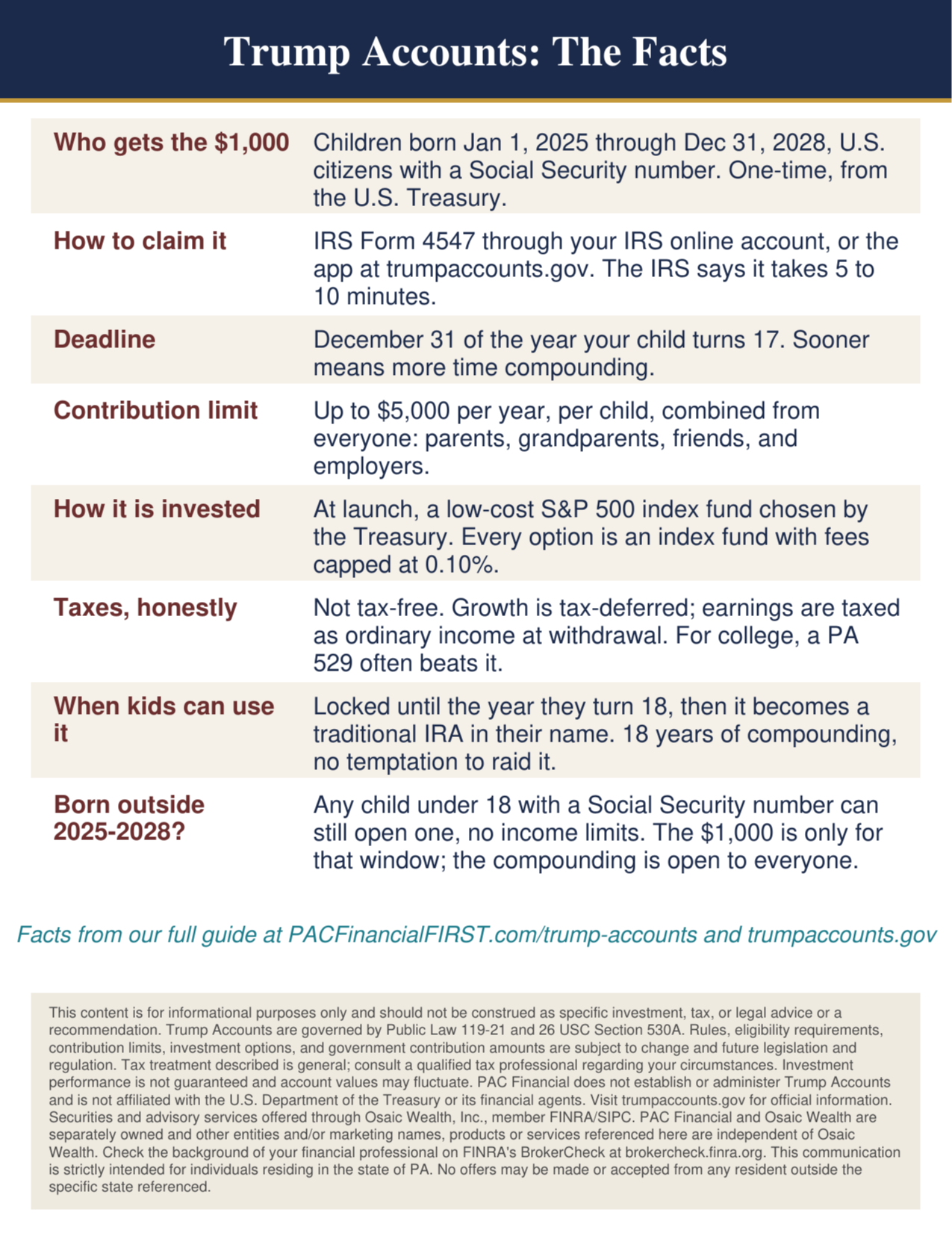
Trump Account information card front, PAC Financial Harrisburg Trump Account facts card back, PAC Financial Harrisburg
Prefer paper? We made a two-sided pocket card with the plain-English facts on one side and how to reach us on the other, the same information as this page, sized to hand to a friend. PAC_Trump_Account_Card_425x55.
Compliance Notice
This content is for informational purposes only and should not be construed as specific investment, tax, or legal advice or a recommendation. Trump Accounts are governed by Public Law 119-21 and 26 USC Section 530A. Rules, eligibility requirements, contribution limits, investment options, and government contribution amounts are subject to change and future legislation and regulation. Tax treatment described is general; consult a qualified tax professional regarding your circumstances. Investment performance is not guaranteed and account values may fluctuate. PAC Financial does not establish or administer Trump Accounts and is not affiliated with the U.S. Department of the Treasury or its financial agents. Visit https://trumpaccounts.gov/ for official information. Securities and advisory services offered through Osaic Wealth, Inc., member FINRA/SIPC. PAC Financial and Osaic Wealth are separately owned and other entities and/or marketing names, products or services referenced here are independent of Osaic Wealth. Check the background of your financial professional on FINRA's BrokerCheck.