


Quick answer: A rental property generally behaves like a long-term bond: steady payments, often borrowed money underneath, and a value that tends to fall when interest rates rise. Many Central Pennsylvania landlords already carry interest-rate risk without owning a single bond. PAC Financial in Harrisburg helps owners build liquid accounts around that fact, coordinated with their tax professional. Call (717) 564-6400, ext. 181.
Ask a landlord in Harrisburg or Mechanicsburg what the 10-year Treasury did this month and you may get a shrug. Ask what happened to his refinance quote, his cap rate, or the offer on a duplex since 2022, and you will hear about interest rates in everything but name.
Here is the plain version: your rental portfolio pays you like a bond, usually borrows like a bond, and tends to lose market value when rates rise, like a bond. For most leveraged portfolios, the single biggest exposure is a sustained rise in interest rates. If your debt is fixed and long, or you carry none, your exposure is smaller; part of the work is knowing which owner you are.
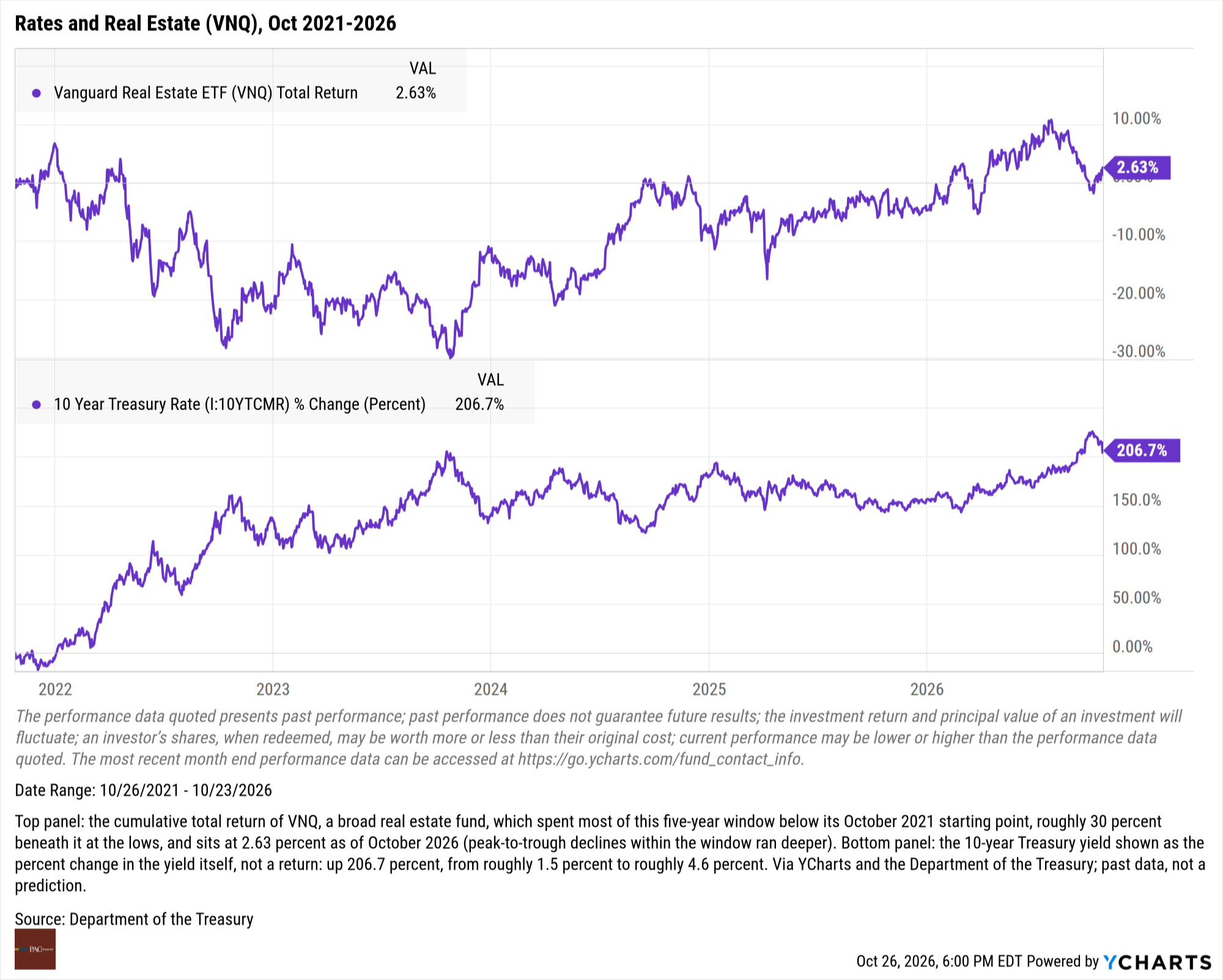
Charts use VNQ, the Vanguard Real Estate ETF, as a general proxy for publicly traded U.S. real estate. Real estate is local and every property is different; no fund or index tracks your buildings, and the proxy is used for general illustration only, not as a measure of any individual property or market. Chart data via YCharts, as of October 2026.
Why do rising interest rates affect rental property values?
Generally two ways. First, buyers of income property price it against what safer income pays. When Treasury yields rise, buyers demand more income per dollar of price, which is another way of saying prices tend to soften. Second, portfolios that carry mortgages reprice their debt at every reset or refinance. Rents push back, but typically on a slower clock: leases generally reset about once a year, so for many owners the costs move faster than the income. For what today's rates are doing to the market owners would sell into, see what a 7 percent mortgage means for Central Pennsylvania landlords.
| Line on the landlord's ledger | How fast it generally reprices |
|---|---|
| Rent | About once a year, at lease renewal |
| Mortgage | At reset or refinance; fixed-rate debt holds until then |
| Insurance | Annually, on the carrier's schedule |
| Property taxes | On the county's reassessment schedule |
Consider a hypothetical: two Lebanon County owners collect the same rents. One carries fixed debt locked in years ago; the other faces a reset next spring. Same buildings, same tenants, very different exposure to the same interest-rate move.
What does that mean for the rest of my money?
It means the standard advice, "put some money in bonds for safety," deserves a second look in your specific case. Bonds are a fine tool for investors whose wealth is not already rate-sensitive. But for many leveraged owners, the real estate already behaves like the bond side of the balance sheet, with borrowed money attached. Adding more rate-sensitive holdings beside it, more bonds, bond-like dividend payers, more property, can stack that exposure rather than balance it. What happened in 2022, when rate-sensitive assets fell together, is the clearest recent picture of why.
What tends not to depend on interest rates and housing?
Generally, businesses whose customers are not the US housing market and whose value does not move with the 10-year Treasury. The useful question is the revenue driver: who pays the company, and does that payment shrink when rates rise or housing slows? A liquid account built around that question looks different from a standard balanced portfolio. It still carries market risk of its own, including the possibility of loss, and in a broad panic very little is immune. The goal is independence from your largest existing risk, not a promise of safety.
Tucker Nicholas is a Private Wealth Advisor at PAC Financial in Harrisburg, Pennsylvania, working alongside Steve Marrazzo. If you want to see how your own ledger reads, the first meeting has three chairs: you, your tax professional, and us. Call (717) 564-6400, ext. 181.
This material is for general information only and is not investment, tax, or legal advice, nor a recommendation of any specific security or strategy. Investing involves risk, including possible loss of principal. Past performance does not guarantee future results. PAC Financial does not provide tax or legal advice; consult a qualified tax professional about your situation. PAC Financial provides investment advisory and brokerage services and receives compensation for those services; depending on the services selected, accounts are advisory or brokerage, and the differences and costs of each are explained in writing before any account is opened. Securities and advisory services offered through Osaic Wealth, Inc., member FINRA/SIPC. PAC Financial and Osaic Wealth, Inc. are separately owned and other entities and/or marketing names, products or services referenced here are independent of Osaic Wealth, Inc. Check the background of your financial professional on FINRA's BrokerCheck. Tucker P. Nicholas is registered in PA, CO, and DE. PAC Financial, 5291 Devonshire Road, Harrisburg, PA 17112, (717) 564-6400.