


Quick answer: A REIT fund will never track your buildings, but it has tended to move with the same force that moves them: interest rates. The same has been true of other steady-income sectors for long stretches. For a Central Pennsylvania landlord, real diversification starts with the revenue driver, not the label. PAC Financial in Harrisburg can walk you through it with your tax professional at the table. Call (717) 564-6400, ext. 181.
When a property owner finally opens an investment account, the first instinct is usually to buy what feels familiar: real estate funds, utilities, steady dividend payers. It feels prudent. The chart below shows how closely that familiar list has tracked publicly traded real estate over the past five years.
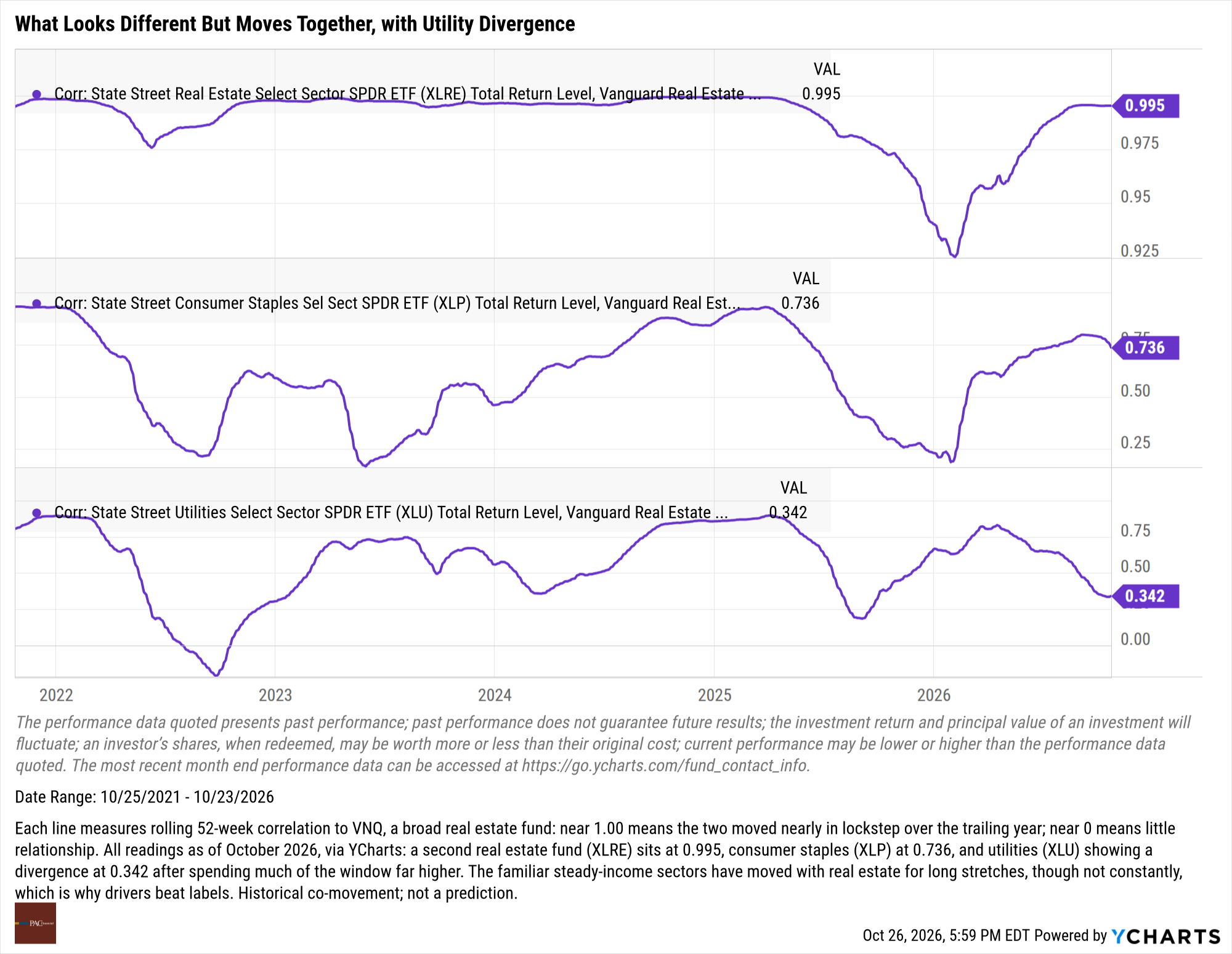
Charts use VNQ, the Vanguard Real Estate ETF, as a general proxy for publicly traded U.S. real estate. Real estate is local and every property is different; no fund or index tracks your buildings, and the proxy is used for general illustration only. Other funds shown are broad index ETFs named to identify market segments, not recommendations. Data via YCharts, as of October 2026.
The chart shows rolling correlation, a measure of how closely two investments have moved together over trailing 52-week windows. A line near 1 means they have moved nearly in lockstep; near zero means they have moved independently.
Are REITs good diversification for someone who owns rental property?
Start with what is true in their favor. A real estate fund offers things your buildings never will: a daily price, liquidity generally reachable within days, and a spread across hundreds of properties instead of a handful. For some purposes those are real benefits, and a fund will not track your specific buildings; real estate is local, and no index owns your block.
The narrow question here is different: does it diversify you away from real estate? Generally it has not. What a REIT fund shares with your buildings is not the address; it is the driver. Both are long streams of property income, priced against interest rates, and they have tended to move through the same rate cycle together. For that one job, owning something that behaves differently from what you already have, a REIT fund has usually been the least different choice available. The two big real estate funds track each other at 0.995 as of October 2026: same asset class, two wrappers.
Why do utilities and consumer staples move like real estate?
They have tended to be, financially speaking, cousins: slow-growing streams of steady income, priced against interest rates. When rates rose sharply in 2022, they generally fell together. The honest nuance is that the link comes and goes: utilities read 0.342 against VNQ as of October 2026 after spending long stretches far higher. A relationship that appears and disappears is exactly why sorting by revenue driver beats trusting a label.
How deep do these sectors actually perform during drawdowns?
Depth of decline is the risk number worth knowing before assuming the familiar names are the calm ones. The table below shows the deepest peak-to-trough decline of each S&P sector fund and VNQ on total returns over the three years ended October 2026, per YCharts. Real estate experienced the deepest drawdown in this set. Declines like these are part of liquid market history; daily pricing makes them visible in a way appraisals never show, and they are real losses when realized.
| Sector fund | Deepest 3-year drawdown |
|---|---|
| Consumer staples (XLP) | -14.5% |
| Health care (XLV) | -17.1% |
| Industrials (XLI) | -18.5% |
| Energy (XLE) | -20.1% |
| Financials (XLF) | -21.4% |
| Materials (XLB) | -23.2% |
| Communication services (XLC) | -25.2% |
| Utilities (XLU) | -25.3% |
| Technology (XLK) | -25.7% |
| Consumer discretionary (XLY) | -28.8% |
| Real estate (XLRE) | -34.1% |
| Real estate (VNQ) | -34.5% |
Deepest peak-to-trough decline, total return, three years ended October 2026, per YCharts. Past declines do not predict future ones; funds named to identify market segments, not recommendations.
What is real diversification from real estate?
Sort by driver, not by label. Ask who pays the business, and whether that payment depends on US interest rates, US housing, or the local economy your buildings sit in. The further the answer sits from those three, the more independent the holding has tended to be. And hold genuine liquidity: cash and short-term instruments do the one job a building cannot, although even they have off years in real terms. Every alternative carries its own risks, including the possibility of loss, and diversification does not assure a profit or prevent losses in a declining market. Independent does not mean safe.
Consider a hypothetical: an owner sells a Palmyra fourplex and puts the proceeds into a real estate fund and two utility stocks, because they feel familiar. On paper he sold real estate. In how the account behaves, he has kept much of the same exposure, now with a daily price to watch.
Tucker Nicholas is a Private Wealth Advisor at PAC Financial in Harrisburg, Pennsylvania. Before the familiar-feeling portfolio gets built, bring the question to the three-chair meeting: you, your tax professional, and us. Call (717) 564-6400, ext. 181.
This material is for general information only and is not investment, tax, or legal advice, nor a recommendation of any specific security or strategy. Investing involves risk, including possible loss of principal. Past performance does not guarantee future results. PAC Financial does not provide tax or legal advice; consult a qualified tax professional about your situation. PAC Financial provides investment advisory and brokerage services and receives compensation for those services; depending on the services selected, accounts are advisory or brokerage, and the differences and costs of each are explained in writing before any account is opened. Securities and advisory services offered through Osaic Wealth, Inc., member FINRA/SIPC. PAC Financial and Osaic Wealth, Inc. are separately owned and other entities and/or marketing names, products or services referenced here are independent of Osaic Wealth, Inc. Check the background of your financial professional on FINRA's BrokerCheck. Tucker P. Nicholas is registered in PA, CO, and DE. PAC Financial, 5291 Devonshire Road, Harrisburg, PA 17112, (717) 564-6400.